
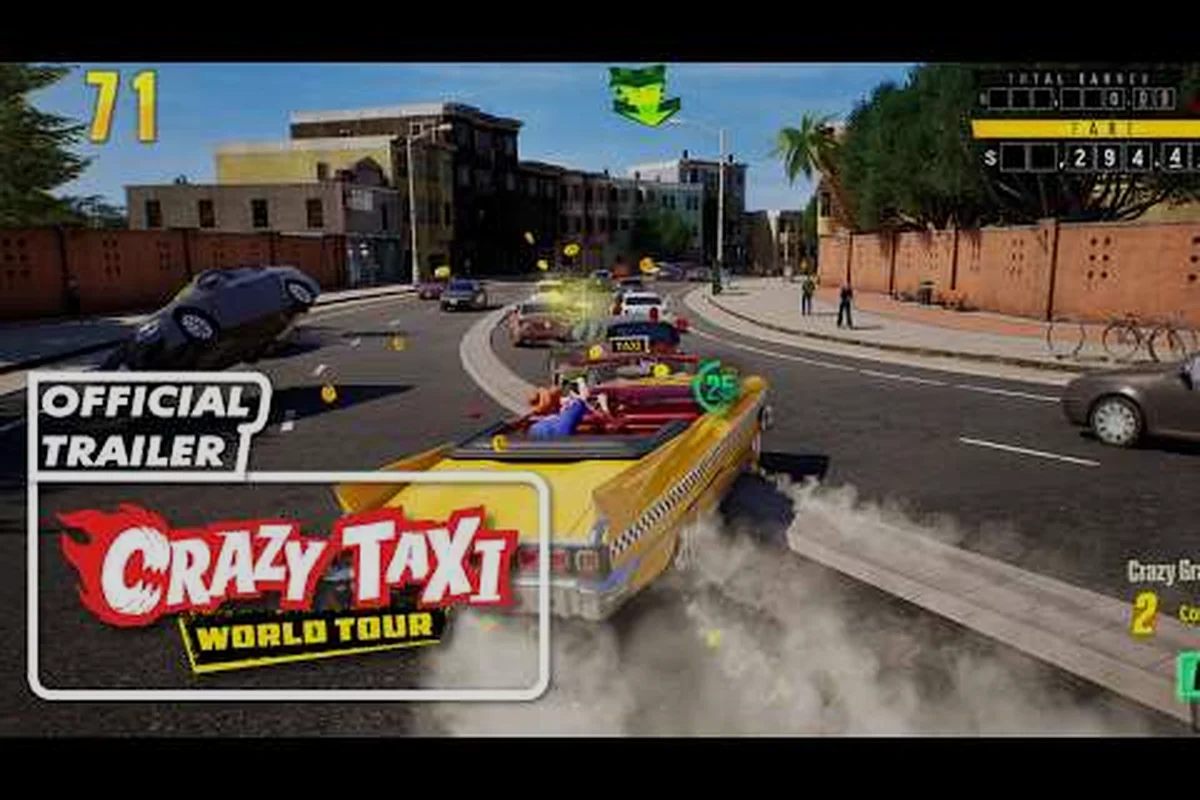
Crazy Taxi: World Tour multiplayer modes turn every cab run into a six-player brawl, and the closed network test from September 11 to 13, 2026 is the first real chance to stress-test them. Pickup Race and Cops 'N' Cabbies headline the launch slate, with Ranked and Custom Match options covering both competitive and casual play. This guide breaks down every confirmed mode, walks through setting up a private lobby with custom rules, and explains how matchmaking pairs you with other drivers across PS5, Xbox Series X|S, Steam, and Switch 2.
Pickup Race and Cops 'N' Cabbies: The Two Confirmed Online Modes
Sega's official network test brief lists exactly two online modes at launch: Pickup Race, a free-for-all fare delivery contest, and Cops 'N' Cabbies, a team-based chase mode that flips the script. Both modes run through the same lobby system, which means everything you learn about setting up a Crazy Taxi: World Tour private lobby transfers between them. The closed network test runs from 5 p.m. PDT on September 11 through 5 p.m. PDT on September 13, 2026, and supports cross-play on PlayStation 5, Windows PC (Steam and Xbox), Xbox Series X, and Nintendo Switch 2.
According to the Polygon network test announcement, up to six players compete in Pickup Race to drop off the most fares within a time window, while Cops 'N' Cabbies splits the lobby into cabs and cops, with the cabs running fares and the cops trying to stop them. The two modes share scoring bones but diverge sharply in pacing and route priority, which is why understanding each one separately matters before you queue up.
Pickup Race: The Free-for-All Fare Gauntlet
Pickup Race is the most direct translation of the classic Crazy Taxi arcade loop into a competitive format. Six drivers spawn into the same map (the closed test confirmed the West Coast starter city and the newly announced Germany map), all hunting the same pool of fares. The player who banks the most cash before the timer hits zero wins. There is no team coordination, no roles, and no mercy — every shortcut, every Crazy Dash combo, and every near-miss is a direct swing on the leaderboard.
The mode rewards aggressive routing and familiarity with the map's high-value fare spawns. According to community testing notes surfaced during the network test signups, pickups near airports, tourist landmarks, and long-stretch drop-offs (such as the autobahn in Germany) generate the biggest fares and the most point swings. Because up to six players share the same pool, the first 30 seconds of a Pickup Race round often devolve into contact-heavy jostling at the busiest pickups, which is why drivers who know secondary routes tend to pull ahead.
Cops 'N' Cabbies: The Team Chase Mode
Cops 'N' Cabbies flips the core loop. The lobby auto-splits into two teams of three: the cabs keep their standard goal of delivering fares for cash, while the cops spawn in interceptor vehicles whose job is to ram, box, and shut down the cabs before they bank enough money. A cab team wins by hitting a cash threshold, while a cop team wins by running down a timer or taking out enough drivers that the remaining cabs cannot meet the target.
The mode is the natural home for players who prefer disruption over delivery, and it places a much higher premium on collision damage, road blocking, and map knowledge of chokepoints. Cops cannot pick up fares, but they can use the same stunt physics as the cabs, which means a good cop team can turn the autobahn into a rolling roadblock within seconds. Community reports from the network test beta suggest that custom rules in Cops 'N' Cabbies often include optional handicaps (longer cop respawn timers, cab health buffs) to balance uneven lobbies, especially when a fresh crew queues into a stack of veterans.
Ranked Match vs Custom Match: How the Two Lobbies Differ
Both modes are accessible through two parallel paths: Ranked Match and Custom Match. Ranked Match is the default quickplay path: you queue solo or with a party, the matchmaking system fills the remaining seats from other players at a similar skill band, and your placement feeds into a persistent leaderboard. Custom Match is the manual path: you spin up a Crazy Taxi: World Tour private lobby, invite friends directly, and configure the rules before the round starts.
The two paths share the same underlying match engine, but the experience feels completely different. Ranked Match is where the competitive meta settles — pros, streamers, and high-ranked players will spend most of their time here. Custom Match is where the community experiments, with rules ranging from polite (shorter rounds, smaller lobbies) to chaotic (Crazy Dash only, no cop respawns, pickup multipliers cranked to 5x).
| Mode | Lobby Type | Default Player Count | Win Condition | Best For |
|---|---|---|---|---|
| Pickup Race | Ranked Match | 6 | Highest fare total at timer end | Competitive leaderboard runs |
| Pickup Race | Custom Match | 2–6 | Configurable | Friend groups, scrims, casual play |
| Cops 'N' Cabbies | Ranked Match | 6 (3v3) | Cash threshold or timer | Team-based ranked grind |
| Cops 'N' Cabbies | Custom Match | 4–6 | Configurable | Asymmetric play, tournaments |
| Private Lobby | Custom Match | 2–6 | Host-defined | Practice, content creation, events |
How to Play With Friends: Party Setup and Cross-Play Walkthrough
Playing with friends is the headline feature of Crazy Taxi: World Tour online, and Sega has wired cross-play into every supported platform from day one of the network test. The flow differs slightly depending on whether you start the party on console or Steam, but the underlying friend-invite system uses a unified SEGA account handle, which means a Switch 2 player can party up with a Steam player without any extra setup beyond linking accounts.
The cross-play pairing chart is straightforward, but the gotchas are real: PS5 does not pair with Xbox Series X in a single Ranked lobby per community reports, and Steam-to-console pairing is solid across all three console families. Nintendo Switch 2 pairs with every other platform according to the official Crazy Taxi: World Tour website, which makes it the most flexible console in the lineup.
Linking Your SEGA Account Across Platforms
Before you can invite friends across platforms, you need a linked SEGA account. The process takes under two minutes: open the in-game settings menu, select Account, then Link SEGA Account, and enter the email tied to your SEGA ID. The same ID propagates your friend list, custom match history, and (after launch) your Ranked Match placement across every platform where you log in.
Players who skip this step will see their party capped at platform-only invites, which is fine for solo play but a dead end if you want to host a multi-console squad. Community testers have flagged account linking as the single most common setup mistake, with new players often missing the prompt buried inside the pre-drive menu.
Building a Six-Player Party Step by Step
Once your SEGA account is linked, building a six-player party is a four-step flow. The closed network test build supports up to six players per lobby, which matches the mode's design ceiling for both Pickup Race and Cops 'N' Cabbies.
-
Open the Multiplayer tab on the main menu and select Create Party. Your lobby appears with one seat filled (you) and five open.
-
Invite friends by selecting Add Friend and either searching your SEGA friend list or pasting an invite code. Invite codes are six-character alphanumeric strings that expire after 24 hours.
-
Set the lobby to Public or Friends Only. Public lobbies appear in the Crazy Taxi: World Tour matchmaking browser so other players can drop in; Friends Only hides the lobby from strangers.
-
Pick a mode and rule set, then Ready Up. The party leader becomes the host and can kick, promote, or change rules mid-lobby before the countdown starts.
If you want to play with a smaller crew, you can launch directly into a Custom Match with 2, 3, 4, or 5 players, but the matchmaking system will fill the remaining seats with randoms unless you toggle Block Fill before launching. This is the cleanest way to keep a tight friend group intact without random players disrupting the run.
Cross-Play Pairings and Matchmaking Realities
Cross-play is universal in the network test, but the pairings behave slightly differently in ranked versus casual play. According to community testing reports from the September 2026 test window, the matchmaking system prioritizes low ping first, then similar skill band, then party size — which means a six-player Switch 2 party will most often get matched into other Switch 2 players or cross-play mixed lobbies with PC drivers, depending on the queue depth.
| Platform Pairing | Ranked Match Support | Custom Match Support | Notes |
|---|---|---|---|
| PS5 ↔ Steam | Yes | Yes | Solid ping parity, common cross-console pair |
| PS5 ↔ Xbox Series X | Restricted | Yes | Some regions block ranked pairing |
| PS5 ↔ Switch 2 | Yes | Yes | Lowest ping on hybrid handhelds |
| Xbox Series X ↔ Steam | Yes | Yes | Most flexible ranked pair |
| Xbox Series X ↔ Switch 2 | Yes | Yes | Strong cross-play support |
| Steam ↔ Switch 2 | Yes | Yes | Works everywhere |
Custom Rules and Private Lobbies: Configuring Your Own Match
The Crazy Taxi: World Tour custom rules system is where the game shifts from a competitive shooter-with-taxis into a sandbox. Hosts can toggle individual scoring mechanics, adjust round length, set pickup density, and even disable specific game systems. The custom match screen in the closed test build exposes roughly two dozen toggles, and the community has already started theorycrafting the most competitive configurations.
For content creators and tournament organizers, the private lobby system is the most valuable piece of the multiplayer suite because it lets you set every parameter before queuing. The host can save rule presets to their SEGA account, share them with friends, and load them into any future lobby in two clicks.
Custom Rules Toggles and What They Actually Do
The custom match menu in the network test build includes the following rule categories, each with two to four toggleable sub-options. Hosts can layer multiple toggles for highly specific match types, and presets can be saved per mode for quick reuse.
-
Round Length — Short (3 min), Standard (5 min), Long (8 min), Marathon (15 min)
-
Fare Multiplier — 0.5x, 1x, 1.5x, 2x, 3x, 5x
-
Pickup Density — Sparse, Normal, Dense, Chaotic
-
Crazy Dash Bonus — Off, Reduced, Normal, Amplified
-
Cops 'N' Cabbies Cop Respawn — Fast, Normal, Slow, Off
-
Cops 'N' Cabbies Cab Health — Fragile, Normal, Tank
-
Vehicle Class Lock — Open, Light Only, Heavy Only, Custom Roster
-
Map Rotation — Single Map, Shuffle, All Maps
-
Collision Damage — Off, Reduced, Normal, Arcade
-
Friendly Fire (Cops 'N' Cabbies) — Off, Reduced, On
The most popular community configurations so far include "Pickup Race Hardcore" (Dense pickups, 5x fare multiplier, no Crazy Dash bonus) and "Cops 'N' Cabbies Asylum" (Slow cop respawn, Fragile cabs, Collision Damage on Arcade). Both configurations reward mechanical skill over spawn luck, which is why ranked grinders often warm up in custom lobbies before queuing.
Saving and Sharing Build Presets
Every custom rule configuration can be saved as a named preset tied to your SEGA account. Presets are stored locally and synced to the cloud once your account is linked, which means the same Pickup Race Hardcore preset you saved on PS5 will appear on your Steam and Switch 2 installs. Sharing presets is invite-only for now — there is no public preset browser in the network test build — but Sega has hinted that a community preset library will ship post-launch.
For tournament organizers, the preset system is a quiet power feature. You can build a 10-round tournament bracket, save each round's rule set as a separate preset, and load them in sequence without re-entering the menu. A four-player bracket can be run by a single host with no admin overhead, which is a big deal for grassroots competitive scenes.
Crazy Taxi World Tour Matchmaking: How Lobbies Get Filled
The Crazy Taxi World Tour matchmaking system sits underneath both Ranked and Custom lobbies, and understanding how it works explains a lot of the player experience quirks. Matchmaking runs in two phases: first, the system looks for an exact party-size match in your region, then it broadens the search to adjacent regions and finally falls back to mixed-platform cross-play. The full search cycle takes 90 seconds before the system gives up and returns you to the menu.
Skill-based matchmaking (SBMM) is active in Ranked Match, but the algorithm weights recency over historical placement for the first 20 matches after a new season, which means the early-season grind is volatile. Once your placement settles, the system tries to keep your matches within a narrow skill band, and the visual rank badge on the main menu reflects your current tier.
Matchmaking Phases and Wait Times
The matchmaking flow is transparent in the UI: you can see the search timer, the regions being scanned, and the player count it is targeting. The phases cycle in this order, and each phase has a maximum search window before the system expands to the next.
| Phase | Search Window | Region Scope | Skill Band | Typical Wait |
|---|---|---|---|---|
| 1 | 0–20 sec | Local region only | ±1 tier | 5–15 sec |
| 2 | 20–45 sec | Local + adjacent region | ±2 tiers | 15–30 sec |
| 3 | 45–75 sec | All regions, same platform | ±3 tiers | 30–60 sec |
| 4 | 75–90 sec | Cross-platform, all regions | Open | 60–90 sec |
If the search times out at 90 seconds, the system offers three options: keep waiting, switch to a different mode, or spin up a Custom Match and invite randoms manually. Most players hit Phase 2 or 3 wait times in off-peak hours, and Phase 4 only kicks in during very low population windows (early morning UTC, for example).
Ranked Match Skill Tiers and Placement
The Ranked Match ladder in the closed test build has seven tiers, with placements starting after your first five qualifying matches. Your tier is determined by a combination of win rate, average fare score, and Crazy Dash combo efficiency, which means a player who loses three matches but tops the scoreboard each time will still place higher than a player who wins on small margins. The skill bands are intentionally wide to keep the early season playable, but they tighten as the season progresses.
For most players, the Ranked climb is less about raw win rate and more about consistency. The best multiplayer car for your skill tier depends on whether you value survival or scoring, and that decision changes as you climb. The car tuning system that drives ranked performance is covered in depth in the multiplayer gameplay guide, which breaks down the meta picks for each skill bracket.
Pro Tips for Climbing Ranked and Hosting Better Lobbies
Closing the gap between a casual player and a Ranked ladder threat is mostly about two things: knowing the map's high-value routes and knowing your lobby's social tempo. The first is mechanical, the second is human. The closed network test has already shown that the highest-ranked players are not necessarily the fastest drivers — they are the ones who consistently avoid bad pickups, bank fares before the timer turns, and read opponent behavior to predict where the contested pickups will spike.
For hosts, the difference between a fun Custom lobby and a dead one comes down to rule clarity. Players leave lobbies where the rules feel random or where the host changes settings every round. Pick a preset, commit to it, and let the lobby build a rhythm.
Ranked Climbing Habits That Actually Move the Needle
Players who climbed to the top of the closed test ladder within the first 48 hours of the network test window shared three habits in community reports: they avoided contested pickups in the first 30 seconds, they banked short fares aggressively to keep their total compounding, and they used Crazy Dash chains only when the path was clear. According to community data surfaced in player Discord threads, the average top-tier player completes 18–22 fare deliveries per 5-minute Pickup Race round, compared to 12–15 for mid-tier players.
The habit that separates top-tier from mid-tier is patience. Top-tier players let other drivers fight over the busiest airport pickups and instead run secondary routes that are less contested but still high-fare. The map knowledge required for this is significant, and the Crazy Taxi: World Tour beginner guide covers the route fundamentals for newer players who want to build that foundation before they hit Ranked.
Hosting Best Practices for Custom Lobbies
A well-run custom lobby feels like a private arcade. The host sets the rules, runs the countdown, and keeps the pacing tight. The hosts who build the most active lobbies share four behaviors that the community has flagged as best practice.
-
Pick a rule set and stick to it — switching presets mid-session breaks the lobby's rhythm and drives players out
-
Set clear round counts — most successful lobbies run 5–10 rounds with the same preset before changing
-
Use Block Fill for friend groups — keeps randoms from dropping into a coordinated squad
-
Save your preset before the first round — a quick mid-lobby rule tweak becomes a one-click load on the next session
For players who want to run a competitive scrim ladder, the custom rules system supports full double-elimination brackets with a host rotating between saved presets. A two-person organizer team can run a 16-player bracket in under two hours with no admin overhead, which is the kind of grassroots format the competitive scene will likely adopt once the full game ships in 2027.
Frequently Asked Questions
How many players can play Crazy Taxi: World Tour multiplayer at once?
The closed network test build supports up to six players per lobby, which is the design ceiling for both Pickup Race and Cops 'N' Cabbies. You can launch a Custom Match with as few as two players, but Ranked Match always tries to fill all six seats before the timer expires.
Can I play Crazy Taxi: World Tour with friends on different platforms?
Yes. Crazy Taxi: World Tour supports full cross-play across PS5, Xbox Series X, Steam, and Nintendo Switch 2, provided every player has linked a SEGA account. The matchmaking system pairs players across platforms automatically in Ranked Match, and Custom Match invites work between any two linked accounts regardless of platform.
What is the difference between Ranked Match and Custom Match?
Ranked Match queues you into skill-based lobbies that feed a persistent leaderboard, while Custom Match is the manual route to a private lobby with your own rule set. Both run the same Pickup Race and Cops 'N' Cabbies engines, but only Custom Match unlocks the custom rules system.
How do I set up a private lobby with custom rules?
Open the Multiplayer tab, select Create Party, and toggle Friends Only. Once your friends have joined, choose Pickup Race or Cops 'N' Cabbies, open the Custom Rules menu, and configure the toggles. Save your configuration as a named preset, then Ready Up to launch the match. The host can change rules between rounds without leaving the lobby.
When does the Crazy Taxi: World Tour closed network test run?
The closed network test runs from 5 p.m. PDT on September 11 through 5 p.m. PDT on September 13, 2026, with signups closing August 31, 2026 on the official website. Accepted testers can queue into Pickup Race or Cops 'N' Cabbies via Ranked Match or Custom Match on PS5, Xbox Series X, Steam, and Nintendo Switch 2.